Published by:
CGP EDU Academic Team
Published on: September 12, 2026
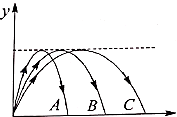
The trajectories of the motion of three particles are shown the figure.
Column I | Column II | ||
(A) | Time of flight is | (I) | |
(B) | Vertical component of the velocity is greatest for | (II) | |
(C) | Horizontal component of the velocity is greatest for | (III) | C |
(D) | Launch speed is least for | (IV) | Same for all |
Text Solution
Verified by ExpertsThe correct answer is:
A
To analyze the motion of the particles A, B, and C, we will look at each statement one by one.
Statement A: The time of flight is based on the horizontal distance traveled and the vertical drop. For trajectories of equal horizontal distance but different peak heights, the time of flight will be different. Particle A has a steeper trajectory, indicating a longer time of flight.
Statement B: The vertical component of the velocity is highest for the particle with the highest peak, which is particle A, since it reaches the greatest height, thus having the highest vertical velocity at the moment of launch.
Statement C: The horizontal component of velocity is independent of any vertical motion, and since particle C travels on a flatter path (less vertical displacement), it will maintain a higher horizontal velocity than A and B. Hence, C has the greatest horizontal velocity.
Statement D: The launch speeds are determined by the initial velocities at launch. Given their trajectories, we see that A, B, and C had different angles suggesting different initial speeds. Therefore, C has the least launch speed.
Thus, we can correlate: A-IV, B-I, C-III, D-II, leading to Option A.
Statement A: The time of flight is based on the horizontal distance traveled and the vertical drop. For trajectories of equal horizontal distance but different peak heights, the time of flight will be different. Particle A has a steeper trajectory, indicating a longer time of flight.
Statement B: The vertical component of the velocity is highest for the particle with the highest peak, which is particle A, since it reaches the greatest height, thus having the highest vertical velocity at the moment of launch.
Statement C: The horizontal component of velocity is independent of any vertical motion, and since particle C travels on a flatter path (less vertical displacement), it will maintain a higher horizontal velocity than A and B. Hence, C has the greatest horizontal velocity.
Statement D: The launch speeds are determined by the initial velocities at launch. Given their trajectories, we see that A, B, and C had different angles suggesting different initial speeds. Therefore, C has the least launch speed.
Thus, we can correlate: A-IV, B-I, C-III, D-II, leading to Option A.
Prepare Smarter with CGP Edu
Get practice questions, solutions, and test series in one place.
Write a Review
Share your experience with this question and solution.
Commentary
Send your comment, doubt, correction, or feedback to admin.
Similar Questions
Explore conceptually related problems
A ball is projected from the ground with velocity such that its range is maximum
Column IColumn II…
The trajectories of the motion of three particles are shown the figure.
Column IColumn II(A)Time o…
Study the following graphs is Column I carefully and match appropriately with the
statements given…
If is the velocity of a man relative to water, is the velocity of water, and
velocity of man rel…
Column IColumn II(A)For a particle moving in a circle(I)The acceleration may be perpendicular to it…
A football player kicks a ball at an angle of to the horizontal with an initial speed of
. Assumi…

